Showing posts with label TJ. Show all posts

August 8, 2013

I have a Black Thumb, but a Green Hammer


The whole question of becoming more resilient always seems to start with growing our own food. With good reason, since without water and food, everything else is eventually moot.

But I am not a gardener. And no matter how many times I have tried, I have not learned to enjoy growing plants, or gotten any better at it.

I often believe in a natural division of labor. It certainly worked for my late wife Trish and I: I built her gardens, she grew stuff in them, I cooked the stuff, and together we ate it. (And evaluated my experimental recipes for disposing of the inevitable garden excess, such as the Twenty Pounds of Green Tomatoes Salsa.)


We were both seriously satisfied, and grateful to each other. I still can see Trish bent over in between her rows of plants, happy, involved and grounded in a way I never understood. I enjoyed helping her harvest, but she was nourished by all the parts of gardening.


(So much so that I got Trish her own chipper shredder for an anniversary present, and she was deeply pleased. Now she could make her own mulch!)


Well, I am not nourished by gardening. It actually drives me a little crazy. Which is why it will not be one of my contributions to resilience.
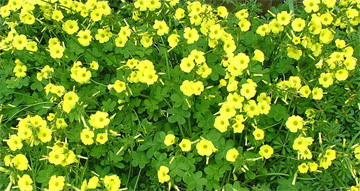
Oxalis

Because I have realized that I work best in a 1:1 ratio of physical work and result. When I lift up a big rock and carry it across the yard, I am happy that it stays put until I choose to move it again. When I cut a board and nail it to another board, I am truly pleased that they stay together, unless I screwed up and need to redo the joint. When I demolish a wall, I am so satisfied that the drywall and lathe and plaster stay in the debris bags and don’t climb back onto the walls overnight.


My experience of gardening is that crook neck squash that you spend weeks growing, that look so healthy and perfect for picking tomorrow, can become shriveled gray blobs by dawn. That when you (naturally) fertilize and feed your soil, oxalis invites itself to the feast, turning your garden green--but not in a fun way.  That your hours of weeding are rendered useless as soon as you water your garden again, given the regenerative capabilities of oxalis. And that basically, nature loves a stockpile, so the more you grow, the more bugs and slugs and invader plants and fungus and deer and not-so-cute-bunnies come to eat it and undo all your work.


Please believe me. I know we need to grow our own food, and that gardening is a challenging, essential task for resilience.


But it isn’t going to be my challenging, essential task.


***


So as part of this project, I will be blogging about my search for how my passions and skills can be as effective and useful as growing food.


Because I can’t be the only terminally non-gardening person concerned about self-reliance and resilience.


Right?


June 28, 2013

I am the Perfect Crash Test Dummy - Part 3


Moenkopi Hopi Wash and Lower Village, my home for two years.


For you to have an accurate picture of what this project feels like from the inside, I need to include my experiences of living powered down and more self-reliantly.


I spent two years living in a Hopi village that had no running water, no sewers, and no electricity. The old Mennonite mission buildings where we were housed had electricity and slowly running water, siphoned from the spring at the edge of the lower village and then stored in a water tank above the mission. (I used to say we had walking, not running, water.)  Heat was by woodstove. For my two years there, I split most of the wood, often with an old coughing chainsaw, but frequently by hand.


Living at the mission meant constant work on its systems, such as the roof, our water supply, our septic system and finishing out enough of the stone barn to house a thrift shop downstairs, and me upstairs. All the work was DIY, although sometimes a retired contractor and his sons came to work on our buildings as their way of supporting the unit. Until a brave entrepreneur built a mini-strip mall two miles away in Tuba City, the nearest useful hardware store was in Flagstaff. Flag was an hour-and-a-half drive when there were no sandstorms, thunderstorms, or blizzards. So if something was broken at the mission, we usually had to find a way to fix it with what was on hand.


Some people who came to the mission found this mode of living too challenging. But I loved it. I had no romantic visions of pioneer or rural life; I happen to relish the kind of mental and physical engagement this way of life requires.


For example, the mission was built into the rocky slope of the wash, and it was held in place by a series of terraces with high stone walls. We used to let lower village families garden in the terraces to help them grow extra food. But one night a village man went off drinking instead of turning off the crude irrigation system we had rigged for the gardens. We didn’t notice it running, because it was in the first terrace above the mission. But we certainly noticed a few nights later when fifty feet of stone retaining wall collapsed , just missing the main mission building.


Me, left, and an occasional helping hand.

I spent weeks rebuilding that wall using mud and the mound of rocks now conveniently close at hand. At first it was overwhelming—so many tumbled rocks, so much sandy earth spilling down from the terrace, and after one day of help from a friend, just me and a shovel and a wheelbarrow. And this on top of my regular daily work, too. 

Figuring out the most efficient process of rebuilding the wall started out as self-defense, but I came to really enjoy the problem solving challenge; how much water with how much earth makes the strongest mortar? The rocks that used to be at the base of the wall are now covered by all the higher rocks that fell onto them—how can I get at and use the heavy bottom rocks without moving every rock twice?


Living this way was certainly harder than using a contractor, or buying a pre-made solution. And there were many times when my reaction was more like, “Oh God, now what?” And I do remember the feeling of never being able to get ahead of anything. Because there was always something newly urgent that needed doing NOW, on top of my official job of running a daily rec center and rec program for the village kids, my unofficial jobs of co-hosting visiting travelers, grant writing, and helping run the weekly church activities.


But the truth is, I felt more alive. I’d spent my previous life in school,  reading and writing and studying, and playing music and working in commercial kitchens. So it was alternately daunting and exhilarating to have so much of my life now be in my own hands—if I could come up with a solution to a challenge with our buildings or with my work with the kids, I could just do it. And if I couldn’t, I’d better keep trying because there was usually no backup.


I’ve included as much self-reliance and simpler living as I could in my later life, from working on the houses I’ve owned—carpentry, roofing, electrical, and plumbing—to putting in gardens and even (God-forbid) gardening.


Now,  I don’t particularly want to have to split logs again, or build a fire an hour before I want the room to be warm.


But I do very much want to live more simply and robustly, so that I can directly engage whatever I need and make it work. This gives me a deep, deep satisfaction that I have never forgotten.


January 2, 2013

I am the Perfect Crash Test Dummy - Part 2


To be as accurate as possible, I realized I needed to include the other side of how I experience sharing life and space with other people.


 I do need my own space, literally and figuratively. But when being around other people is a choice, rather than a requirement, I can enjoy it. I grew up with five brothers and sisters, and sometimes I miss the feeling of a house overflowing with people and activity and conversations. When a musical band I’m in is clicking, it doubles or triples the excitement of performing over playing by myself. When I was a writer and living in Seattle—and they had finally invented laptops—I often would take my computer to a coffee house and write. I enjoy the feeling of having life flowing around me, without having to interact unless I choose.


I can also enjoy what Loni and I call having people “flow through” our space. When I lived in Moenkopi, we had a constant stream of people coming to stay with us at the mission. It was part of our role as a voluntary service unit to host the people from all over the world who were using the “Mennonite Your Way” network to travel across the country cheaply and, in our case, see the Hopi and the Grand Canyon.


Back before the Internet, we never exactly knew who would turn up next, or when. And often as not, they weren’t people with whom I would have chosen to spend time. But there were enough people who were interesting, or who asked in-depth questions about our work in the village or the Hopi, to make having new arrivals be something like opening an unknown present at Christmas. I became good friends with several of our return visitors as we got past surface impressions and got to share and know each others’ lives.


It seems for me it’s a combination of having the right to choose whether to share time/space with people, and who the people are. I know that no one usually has a pure choice about this; I’ve spent lots of time being polite with travelers and others because it would be rude to just leave. But being at home should mean being relaxed and more yourself, so for me to feel ‘at home’ around others means I have some level of choice about sharing.


I don’t yet see how all this can happen in our 1908 Victorian. Having seen Loni’s gift for space planning, and her sensitivity to what people need, I believe that if anyone can figure it out, she will.


But this is my life and our lives and our home, and I’ll have to live with this however it turns out. So sometimes this project does really feel like being a crash test dummy…

December 28, 2012

I am the perfect Crash Test Dummy, Part 1


I’m TJ. And while I happen to be Loni’s partner in life, it turns out I’m also the perfect crash test dummy for this project. So I’ll be sharing my experiences as an active passenger, as we go from plans to remodeling to adding housemates.


I started calling myself the crash test dummy when we first were seriously considering this project. Why?


Because, compared to most other people I’ve known, I have a very high need for physical and personal privacy. Due in part to how I grew up—large family, no private spaces, no respect for boundaries, my father’s profession requiring me to be a public person and under social scrutiny all the time. And in part due to my nature—I’m an introvert in most circumstances, and an empath who more often feels drained rather than energized being around other people. And I’m also a musician with sensitive hearing whose sleep is disturbed by noises.


My de facto solution has been to have as much private physical space around me as possible. Whenever possible as an adult, I’ve had a bedroom to myself as a creative studio and personal lair. When there was no bedroom available, I improvised: to escape living in a triple dorm room in college I moved myself down into the furnace room of the off-campus house. When I lived in the Hopi village of Lower Moenkopi, Arizona, I moved into the unheated upper floor of a stone barn to have space to myself. We were only eighty miles from the Grand Canyon, so at night it was colder than Hades. And I’m not joking. But it was a respite from the constant social flow in the main building of the old Mennonite mission.


(You could also say that by moving onto the reservation, and down inside a desert wash, I was trying to put as much private physical space around me as possible. Once you left the lower village, if you didn’t go up to Tuba City, you could drive your car or ride your horse for hours and not see buildings or other people. When my Hopi friend Lyle was still alive, he would sometimes loan me a horse, and I would ride all day by myself, soaking up the solitude and feeling my way through the seemingly endless desert .)


So, our thinking goes that if Loni, with input from me, can do space planning that adds two or three new people to our existing house AND gives me enough experience of privacy to be comfortable-- well, you’ve got some good crash test results.